
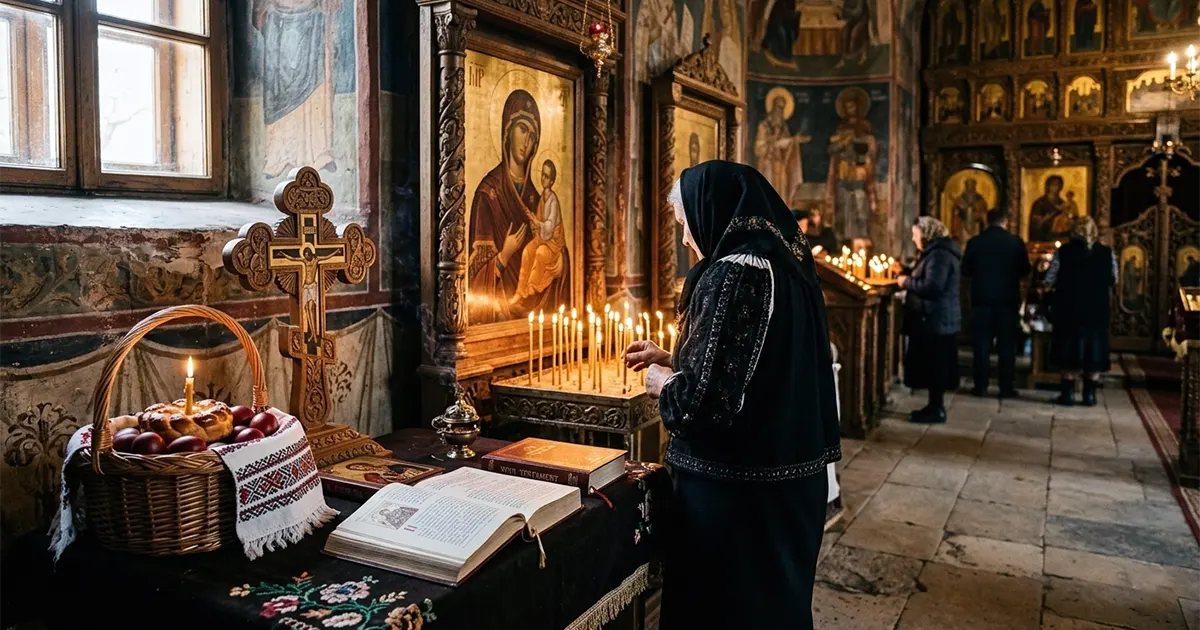
 Holy Week (the Week of Passions) in Romania is a profound interval of suspended time, where strict Orthodox liturgy intertwines with ancestral folk beliefs that predate the modern era. Beyond the solemn church services marking the final days of Jesus on Earth, Romanian villages maintain a universe of symbolic gestures designed to purify both the home and the spirit for the Resurrection. This is a time when the “world is renewed,” and the boundary between the sacred and the earthly becomes remarkably thin.
The Denii Services and the Silence of the Community
From the very beginning of the week, the atmosphere in rural settlements shifts. Every evening, the rhythmic sound of the toaca (a wooden percussion board) and the tolling of church bells call the faithful to the Denii. These unique, dramatic evening services invite meditation and humility.
Monday and Tuesday are traditionally dedicated to “deep cleaning.” In the regions of Bukovina and Mures, it is believed that not a single inch of garden soil should remain undug, and houses are whitewashed to better reflect the Paschal light. This act of refreshing the living space is seen as a form of respect for the holiness of the coming days—a ritualistic purging of winter’s remnants.
By Holy Wednesday, heavy agricultural work must cease. In parts of Moldavia, local lore suggests that men must stop all field labor by this afternoon or risk bringing droughts upon their crops. From this point forward, the entire family’s energy shifts exclusively toward the hearth and the church.
Holy Thursday and the Fires for the Ancestors
One of the most breathtaking rituals, preserved with archaic rigor in the villages of Oltenia and Muntenia, occurs on the morning of Holy Thursday. Before sunrise, small fires are lit in courtyards, at gravesites, or at crossroads using hazelwood or wormwood branches. In Romanian folk cosmogony, it is believed that the heavens open on this day, and the spirits of the ancestors return to their old homes to spend the holidays with the living. These fires are not merely purifiers; they represent ritual hospitality, intended to warm the souls of the departed and provide light for their journey back.
This is also the day when housewives begin preparing the primary ritual foods. It is the traditional time to dye the first red eggs, a gesture commemorating the legend that a basket of eggs placed under the Cross was stained by the blood of the sacrifice. Tradition holds that eggs dyed on Holy Thursday possess special protective powers: they do not spoil throughout the year and are kept near icons to protect the home from hailstorms, lightning, or illness.
Good Friday: The Symbolic Tomb and the Lamentations
The most somber day of the year, Good Friday, is marked by absolute silence. It is a day of “Black Fasting,” where many refrain from both food and water until sunset. Inside the churches, the Sfântul Epitaf—a cloth icon depicting the body of Christ being prepared for burial—is placed in the center of the nave, surrounded by flowers brought by the locals. The ritual of passing underneath this symbolic tomb is an act of deep humility and a personal sharing in the Passion, representing for many Romanians the most emotionally charged moment of the entire year.
In the evening, under the pale glow of candlelight, the community gathers for the Prohodul (The Lamentations). This service, essentially a cosmic mourning song, ends with a procession around the church. The image of hundreds of people carrying flickering lights through the darkness transforms each village into a river of light, foreshadowing the victory of life over death. From this moment on, death is no longer seen as an end, but as a necessary transition toward the light.
Holy Saturday: The Final Preparation and the Cosmic Wait
Holy Saturday is dedicated to the final administrative details of the household and the preparation of foods to be blessed early Sunday morning. The Pasca—a ritual bread with sweet cheese representing the sun and the earth’s bounty—is baked alongside the Cozonac (sweet walnut bread). In Transylvania, the custom of “decorating the gates” with green branches remains a vibrant sign of nature’s rebirth and hope.
The atmosphere is one of silent expectation—a “full silence” that dominates the village. In mountainous areas, the youth often strike the toaca continuously to ward off negative energies and mark the irreversible passage of time toward midnight. When the first bells finally announce the Resurrection, Holy Week officially ends, giving way to the greatest celebration in the Christian world. This succession of rituals, from the fires of the ancestors to the Light of the Resurrection, has defined the spiritual resilience of the Romanian people for centuries.