
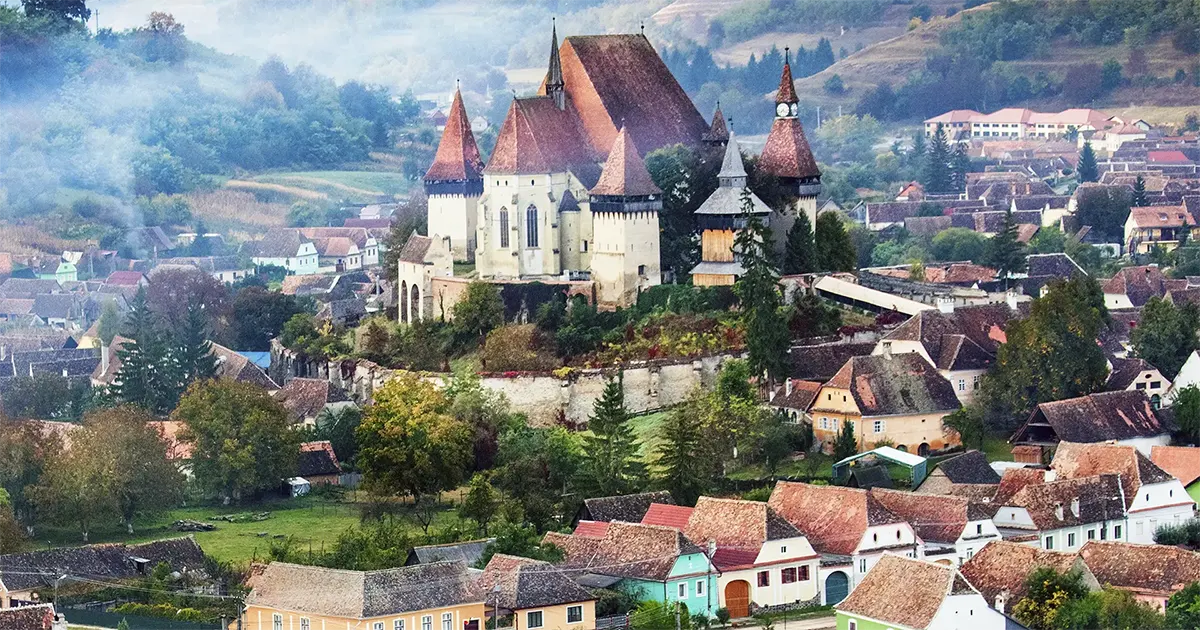
Perched on a hill in the heart of Biertan, a picturesque village in Sibiu County, central Romania, the Biertan Fortified Church stands as one of the most remarkable rural fortifications in Transylvania. Located approximately 80 km from Sibiu and about 50 km from Sighișoara, the site is easily accessible and often included in Transylvania travel itineraries.
Its silhouette, often wrapped in mist or surrounded by snowy landscapes, has become an iconic image of Romania’s Saxon heritage.
A former Saxon ecclesiastical center
In the 16th century, Biertan was a thriving economic hub and served as the seat of the Saxon bishopric. This strategic and religious importance made it a frequent target for invasions, prompting the construction of a powerful defensive complex centered around the church.
Gothic architecture and priceless interior elements
Built in the early 1500s as a late Gothic hall church, the structure has preserved its original form to this day. Inside, visitors encounter a rich collection of historical and artistic elements: a monumental altar with 28 painted panels, a 16th-century pulpit, intricately carved choir stalls, and a collection of Anatolian carpets.
One of the most fascinating features is the sacristy door, crafted in 1515. Decorated with intricate inlays, it includes an ingenious locking mechanism that secures the door at 19 different points. This extraordinary piece of medieval engineering was awarded a prize at the Paris World Exhibition in 1900, highlighting its uniqueness.
Historical details and Renaissance influences
The church’s Gothic portal dates back to 1510–1516 and is associated with the reigns of Vladislaus II and John Zápolya. Meanwhile, certain architectural elements—such as the frames of the sacristy and side doors—display early Renaissance influences, marking a stylistic transition of the period.
A complex defensive system
The fortified complex consists of three concentric enclosure walls, six defensive towers, and three bastions, all designed to protect the local community during times of conflict. Access is made via a covered staircase passing by the Gate Tower, where today a small bookstore welcomes visitors.
At the top of the path, just in front of the church, lies a large stone once used for public shaming—where those who broke community rules were displayed before the villagers.