
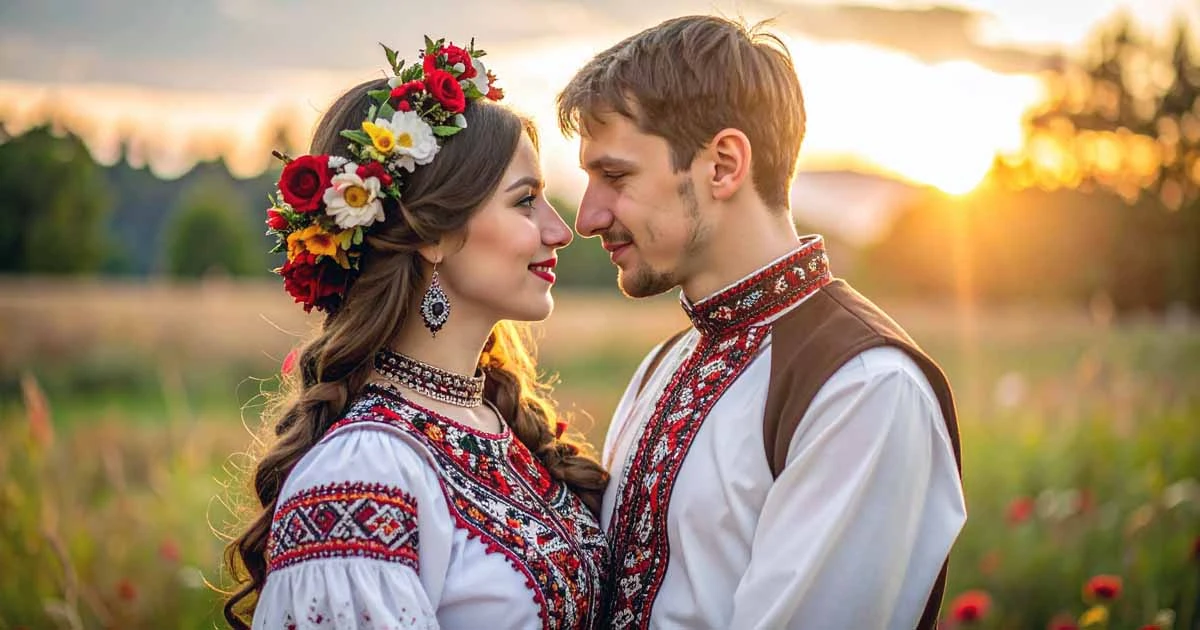
 Dragobete holds a distinctive place in Romanian cultural heritage, often described as the country’s traditional celebration of love. Unlike modern, commercially driven romantic holidays, Dragobete is deeply rooted in folklore, mythology, and the rhythms of rural life, where love was seen as a natural, vital force connected to the cycles of nature.
The Origins of Dragobete
Celebrated annually on February 24, Dragobete originates from Romanian mythology. In traditional folklore, Dragobete is depicted as the son of Baba Dochia, a legendary figure associated with the transition from winter to spring. Dragobete himself was imagined as a youthful, charming protector of love, joy, and renewal.
The timing of the holiday is far from coincidental. Late February symbolically marked the awakening of nature. Birds began pairing, the earth slowly emerged from winter’s stillness, and human communities mirrored this natural revival through rituals centered on affection and connection.
Dragobete was therefore more than a romantic observance. It represented vitality, rebirth, and the return of life’s dynamic energy.
Dragobete in Traditional Romanian Villages
In rural Romanian society, Dragobete was a socially meaningful event rather than a private celebration. Young men and women dressed in festive attire and gathered early in the day. When weather permitted, they ventured outdoors, reinforcing the symbolic link between love and nature.
One of the best-known customs involved playful chasing rituals. If a young man caught a young woman and she accepted a kiss, the gesture was considered a symbolic engagement — a socially acknowledged expression of mutual affection.
Within the context of traditional communities, Dragobete created a culturally sanctioned space for emotional interaction. In societies governed by strict social codes, this day offered legitimacy for courtship and romantic expression.
The Symbolism of Love
Romanian folklore framed love not purely as individual romance but as a force tied to fertility, harmony, prosperity, and continuity. Dragobete embodied this worldview.
Participation in the celebration was believed to bring good fortune, relational stability, and emotional fulfillment. Conversely, ignoring the rituals was sometimes associated with loneliness or misfortune in matters of the heart.
Love, in this framework, functioned both emotionally and socially.
Dragobete vs. Valentine’s Day
In recent decades, Valentine’s Day has gained prominence in Romania, inevitably inviting comparisons.
Valentine’s Day is widely perceived as an urban, globalized celebration with strong commercial associations. Its emphasis often falls on gifts, symbolic gestures, and consumer rituals.
Dragobete, by contrast, carries a traditional, symbolic, and communal character. It is less about consumption and more about participation, interaction, and continuity of cultural identity.
This distinction explains why Dragobete is frequently regarded as a symbol of authenticity within Romanian cultural discourse.
Dragobete in Modern Society
Social evolution has naturally reshaped how Dragobete is understood and observed. Urbanization, globalization, and shifting relationship norms have altered its context.
Today, Dragobete is often rediscovered rather than inherited. Cultural institutions, schools, and local organizations contribute to preserving its visibility through events, educational programs, and media coverage.
For some, Dragobete represents cultural pride. For others, it offers a meaningful alternative to imported celebrations.
A Psychological Perspective
From a psychosocial standpoint, rituals dedicated to love have historically served important functions. They foster social cohesion, facilitate interaction, and reinforce collective identity.
Even within modern, highly individualized societies, symbolic traditions retain psychological relevance. Dragobete fulfills this role by bridging cultural memory with contemporary experience.
Identity, Memory, Continuity
Dragobete is not merely a folkloric curiosity. It reflects how Romanian communities historically conceptualized relationships, emotions, and social bonds.
In a globalized world, local cultural symbols gain renewed significance. They do not oppose modernity; they enrich it by preserving depth, diversity, and historical continuity.
Dragobete ultimately remains a celebration not only of love, but of cultural identity itself.