
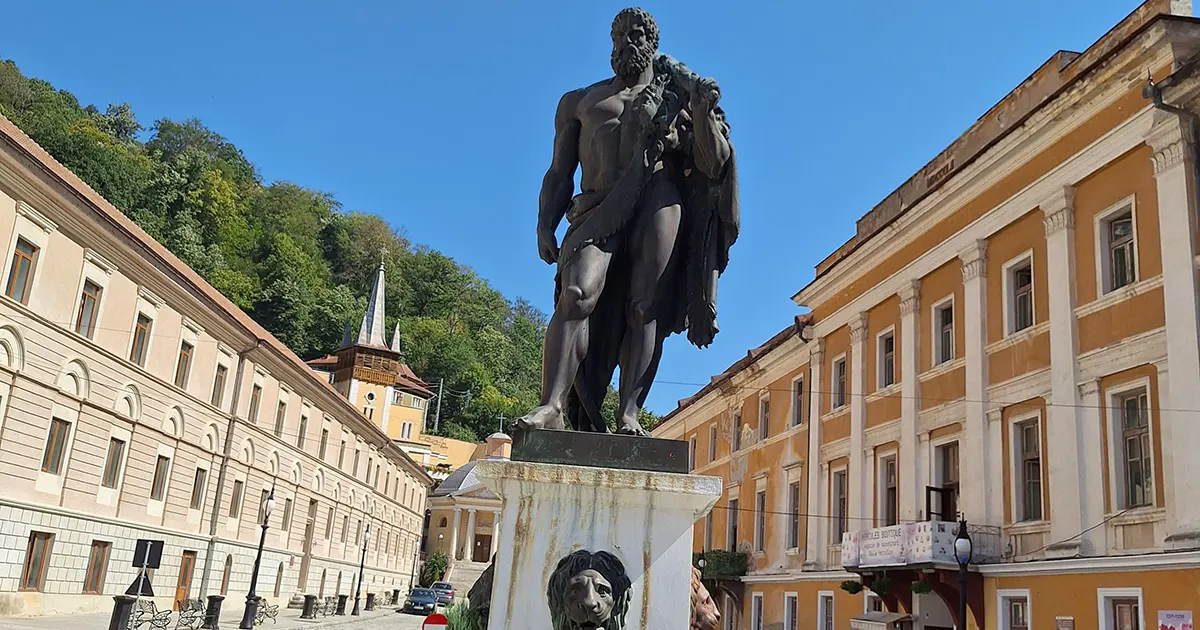
 Băile Herculane is more than just a spa resort; it is an open-air museum where the layers of history overlap with the mystical thermal mists of the earth. In the heart of this timeless universe, dominating Hercules Square, stands a bronze figure that has become, for over a century and a half, the emblem of resilience and power: The Statue of Hercules.
An Imperial Legacy Cast from War Cannons
Although the presence of Hercules in these lands dates back to the Roman era—who named the place “Ad Aquas Herculi Sacras” (To the Sacred Waters of Hercules)—the iconic monument we admire today has its origins in the Austrian Empire.
Its fascinating story began in 1847. The statue was gifted to the resort by Archduke Charles of Austria as a tribute to the officers and soldiers who had regained their health in the healing waters of the Cerna River. A technical yet deeply symbolic detail gives the statue a unique aura: its material. It was cast in Vienna, in the workshops of masters Ramelmayer and Glantz, using bronze from captured Turkish cannons. Thus, metal intended for destruction on the battlefield was metamorphosed into a symbol of life and physical regeneration.
The Symbolism of the Hero’s First Labors
The statue depicts the Greek demigod in a classic, powerful pose. Over his left shoulder, Hercules wears the massive skin of the Nemean Lion, the slaying of which was the first of his twelve legendary labors. In his hand, he holds his legendary club resting on the ground, suggesting a state of repose after exertion—a perfect metaphor for visitors who come to the baths for recovery.
His posture is not merely aesthetic; it reflects the ancient belief that Hercules was the patron of thermal springs. The Romans believed he discovered hot springs to rest after his battles, and the statue’s presence in the center of the resort reaffirms this millennial covenant between divinity and the healing power of nature.
The Architecture of Hercules Square: A Period Backdrop
The statue would not have the same impact without the spectacular setting in which it is placed. It occupies the center of Hercules Square, a Baroque and Neoclassical architectural ensemble unique in South-Eastern Europe. Surrounding it, historic buildings—bath pavilions and aristocratic hotels—tell the story of an era when Herculane was the preferred destination of emperors, including the famous Empress Sisi.
While many of these buildings now bear the painful mark of time, the statue remains a fixed point, a landmark of stability. It draws thousands of tourists annually who come not just for photographs, but to feel the energy of a place where legend blends with reality.
The Statue of Hercules in Băile Herculane is more than a bronze work of art; it is a promise. It reminds us that, regardless of history’s vicissitudes, the thermal springs continue to flow, and the strength of the human spirit—represented by the hero on the pedestal—remains unshakeable.
Did You Know? Fast Facts About the Hercules Statue
-
Forged from War: Did you know the statue weighs over 5 tons and was cast using the bronze from melted Turkish cannons? It is a powerful symbol of turning weapons of war into a monument of healing.
-
A Royal Gift: The statue was a personal gift from Archduke Charles of Austria in 1847, dedicated to the soldiers who found their strength again in the thermal waters of the Cerna Valley.
-
The “Inventor” of Spas: In Roman mythology, Hercules was considered the “patron of hot springs.” Legend says he used these very waters to recover his superhuman strength after completing his 12 Labors.
-
A Survivor of Empires: Despite the decay of some surrounding historic buildings, the statue has remained virtually untouched for over 175 years, surviving world wars and political shifts.
-
Imperial Footsteps: When you stand in front of the statue, you are walking the same ground as Empress Sisi of Austria and Emperor Franz Joseph, who both frequented the square during the resort’s golden age.